
You have probably typed some version of this into ChatGPT or Google at 10:30 at night: "Is my Shopify store compliant?" You get back a wall of text about GDPR articles and cookie consent, and you close the tab no clearer than when you opened it.
Here is a straight answer instead. You do not need to read the wall of text. You can see exactly where your store stands — for free, in under a minute, without signing up for anything.
Start with the free scan
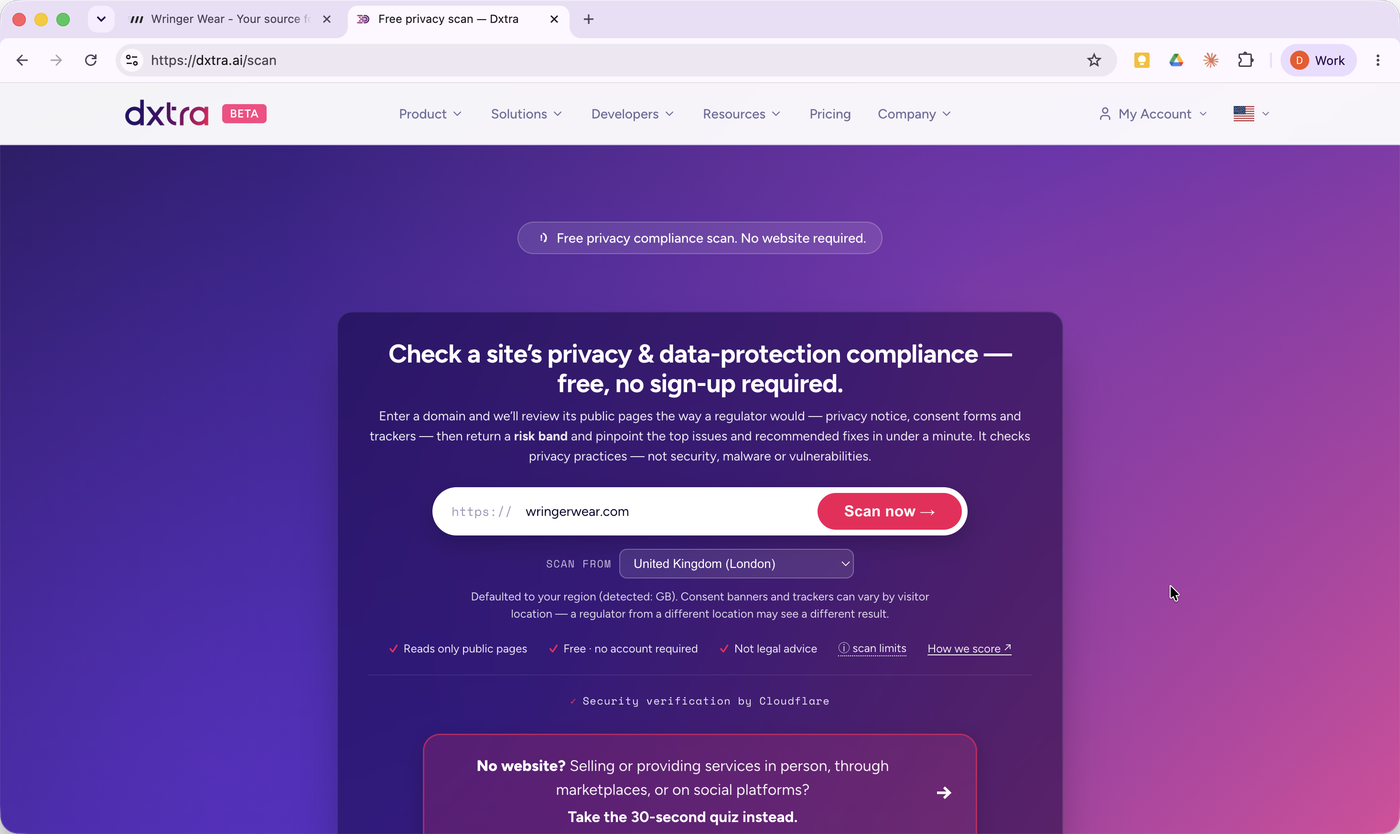
Go to dxtra.ai and click Free privacy scan. Enter your store's web address. That is the whole setup — no account, no credit card, no 30-minute demo call. (For every screen from scan to full report, see the step-by-step scan guide.)
Dxtra then reads your store the way a regulator would. It opens your public pages, finds your privacy notice, checks your cookie and consent banner, and watches which trackers and marketing pixels fire before a visitor has agreed to anything. It picks the laws that actually apply to you from where your store really operates — UK GDPR and PECR, EU GDPR, CCPA/CPRA in California, Australia's Privacy Act, Singapore's PDPA, Japan's APPI — and checks against those, not a generic checklist.
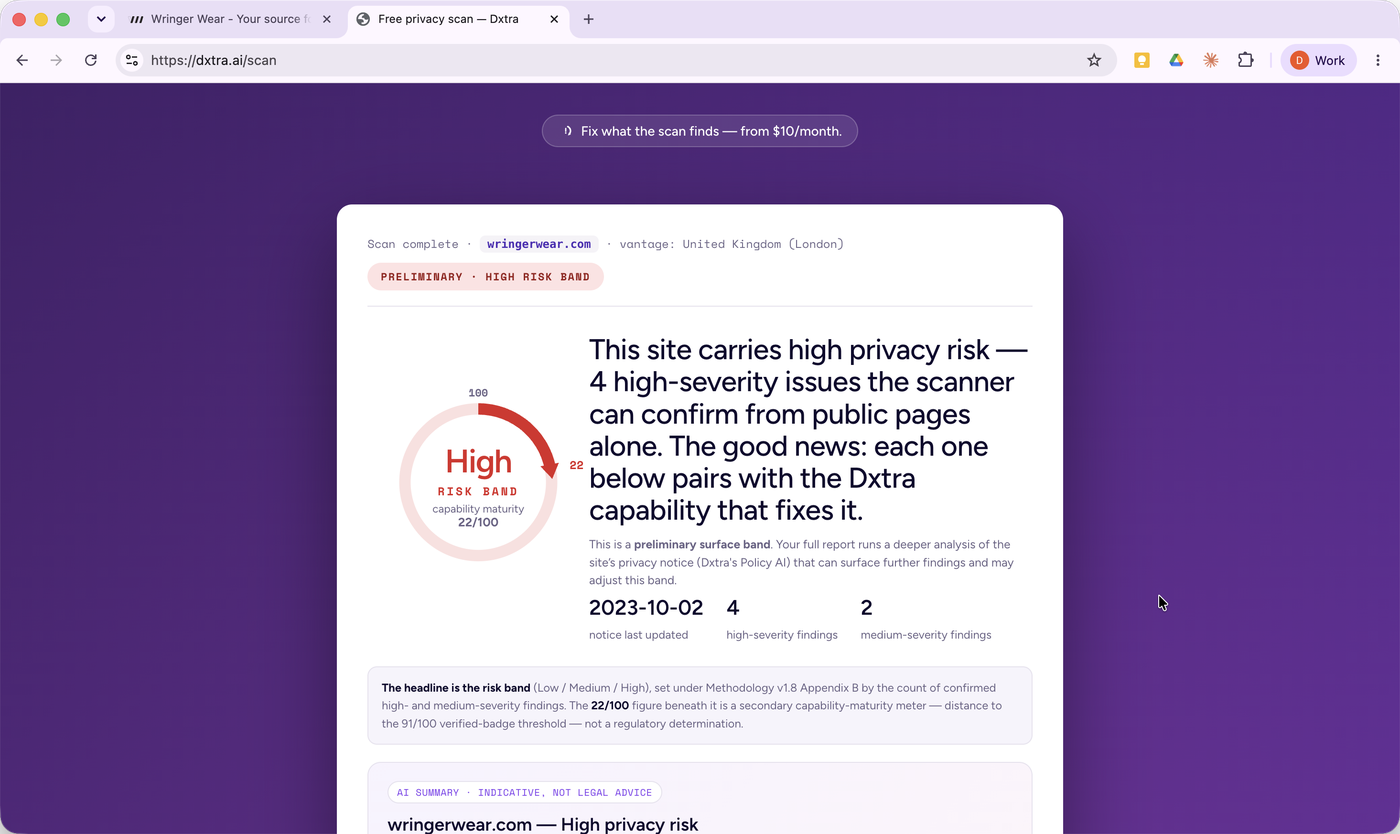
In under a minute you get a risk band — Low, Medium, or High — with the top issues named in plain English, and each one paired with the fix.
What a real store looked like
Take a real Shopify activewear brand we scanned (a US pickleball label, checked from a UK visitor's point of view). The result came back High risk. Not because the owner did anything careless — because of the ordinary things that pile up when you are busy running a store:
- Ad and marketing pixels were firing before anyone accepted cookies.
- The cookie banner assumed consent instead of asking for it.
- A newsletter signup collected emails with no clear consent basis.
- The privacy notice had not been updated in more than two years.
None of that is unusual. Most stores have some version of it. The point is you can see it — named, one by one — instead of guessing. And a reputable, established brand can carry the exact same gaps; we scanned a well-known luxury hotel and it came back High risk too, with trackers that kept firing even after a visitor clicked "Reject All."
Then Dxtra fixes it — in hours, not months
Here is the part that turns the dread into relief. Every issue the scan finds is paired with the Dxtra feature that closes it. Your privacy notice, your cookie consent, your process for answering "delete my data" — handled, from a single place, from $10/month. There is a 14-day money-back guarantee, so you can try it against your own store with nothing at risk.
You do not rebuild your store. You do not hire a lawyer or read 88 pages of regulation. You connect your store, Dxtra generates what is missing, and you review everything before it goes live. A store that scanned in the High band can move to Low — and you get a privacy-posture card you can show a customer, a marketplace, or an enterprise buyer who asks.
What the scan is — and is not
The scan is an accurate diagnostic. It reads only your public pages, and it is written entirely from what your site actually says — it never makes up a finding or a citation. It gives you an indicator of where you stand and what to prioritize. It is not legal advice, and it does not claim you are "compliant" — no tool can promise that, because regulators decide compliance, not software. What it does promise is that when a customer or a regulator asks, you will have an answer ready in minutes instead of weeks.
See where you stand
The scan is free and gives you a result in under a minute. If you have been meaning to "sort out the privacy stuff" for six months, this is the ten-minute version of finally doing it.
No account. No card. Reads only your public pages.
Sources
Current as of 15 October 2026. Laws, thresholds, platform settings and Dxtra's plans change; check the linked source before you rely on any of them.
- Managing customer privacy settings (Shopify Help Center): Shopify lets you set customer privacy settings by region, and says "You're responsible for your own compliance"
- General Data Protection Regulation, Regulation (EU) 2016/679 (EUR-Lex): EU GDPR, the regulation behind consent and privacy notice findings
- Privacy and Electronic Communications Regulations 2003, regulation 6 (legislation.gov.uk): the UK rule on storing or accessing information on a visitor's device (cookies and trackers)
- What are the exceptions? (ICO): the limited UK exceptions to cookie consent, including the statistics-only exception
- What the ICO's transformation into the Information Commission means for your organisation (Lewis Silkin): the UK regulator has been the Information Commission since 30 September 2026 and is still known as "the ICO"
- Updated monetary thresholds in CCPA (California Privacy Protection Agency): CCPA/CPRA business threshold of $26,625,000 annual gross revenue since 1 January 2025
- Small business (OAIC): when Australia's Privacy Act applies to a small business
- Personal Data Protection Act (PDPC): Singapore's PDPA and the obligations it sets for organizations
- Does the APPI apply to overseas businesses? (Personal Information Protection Commission, Japan): Japan's APPI reaches foreign businesses that supply goods or services to people in Japan
- Scan methodology (Dxtra): how the free scan reads public pages, the risk band, and cited findings
- Pricing (Dxtra): plans from $10/month; 14-day money-back guarantee on the START plan
This article is general information, not legal advice. Which rules apply depends on where you sell; confirm anything that matters with your regulator (for example the Information Commission in the UK or the California Privacy Protection Agency) or a qualified adviser before you rely on it.
Selling in person, on social, or through a marketplace instead of your own website? There is a 30-second version for you — see Selling on Instagram, Etsy or from your coffee shop? You still have privacy obligations, and the full step-by-step scan guide.